The Menopause Hour Episode -5
Podcast

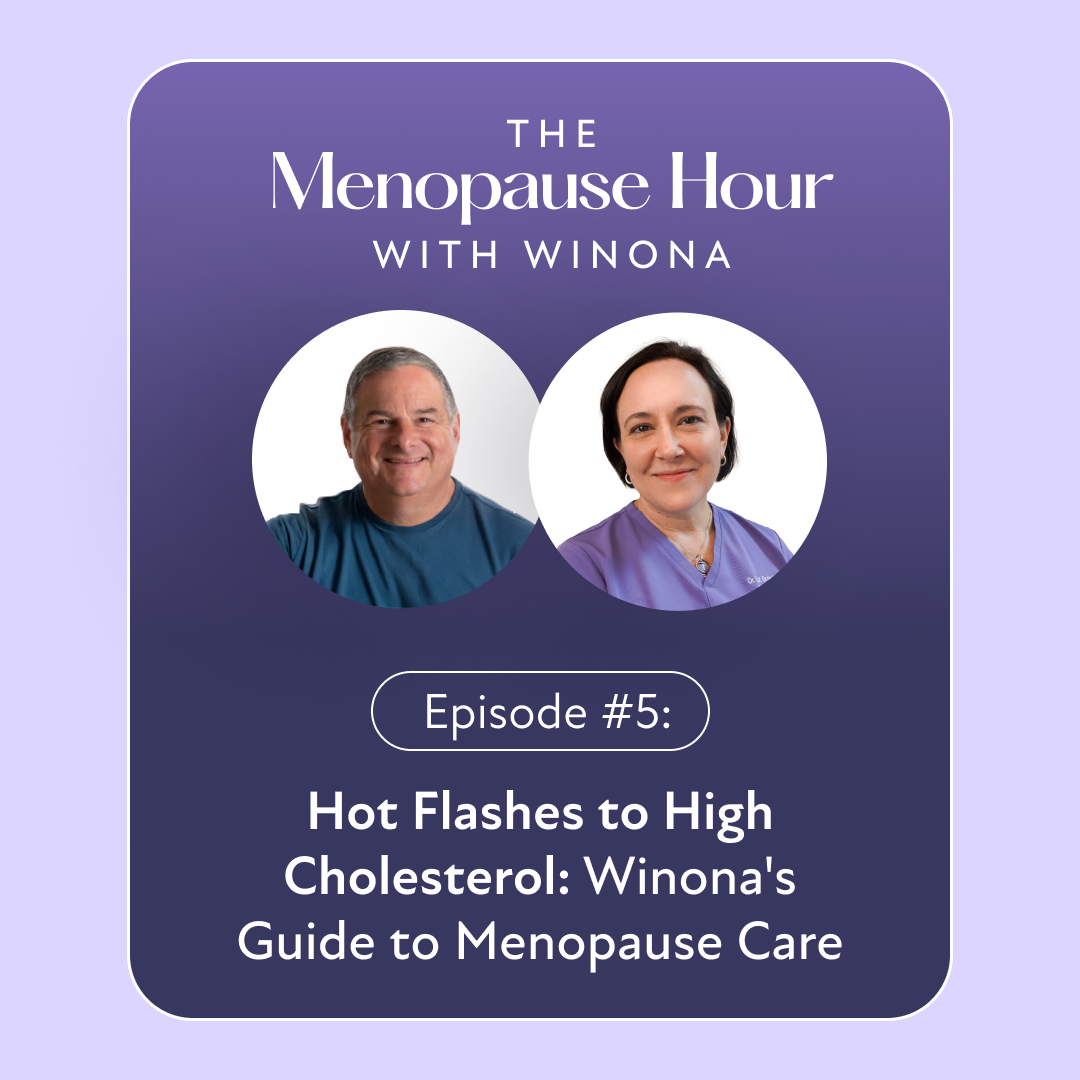
The Menopause Hour with Winona: Hot Flashes to High Cholesterol: Winona's Guide to Menopause Care - Episode #5

Published: January, 2025

Dr. Cathleen Brown

Featured Physician

Cathleen M. Brown

Host

Madi Baldwin

Episode #5 of The Menopause Hour with Winona: “Hot Flashes to High Cholesterol: Winona's Guide to Menopause Care” is a replay of a live Ask the Experts Q&A featuring Winona Medical Director Dr. Cathleen Brown, hosted by Madi Baldwin.

Dr. Cat answered listener questions on topics ranging from how long someone can safely stay on HRT to why menopause can raise cholesterol levels. This episode serves as a practical, evidence-based starting point for anyone considering whether, or how, to start hormone therapy.


LISTEN TO THE EPISODE

Episode Details

  • Podcast: The Menopause Hour with Winona

  • Episode: 5

  • Episode Title: Episode #5: Hot Flashes to High Cholesterol: Winona's Guide to Menopause Care

  • Host: Madi Baldwin

  • Featured Physician: Dr. Cathleen Brown

  • Published Date: January 15, 2025

  • Episode Duration: 1 hr 7 mins

  • Format: Audio Interview

  • Main Topics: HRT safety & effectiveness, Cholesterol & heart health, Symptom management

About The Menopause Hour with Winona Podcast

The Menopause Hour with Winona is a health and wellness podcast featuring Winona Chief Medical Officer Dr. Michael Green and Medical Director Dr. Cathleen Brown. Each episode brings listeners candid, expert-led conversations that answer the menopause questions many women never get to ask their own physician.The show blends live Q&A sessions, doctor-to-doctor dialogues, and real patient stories to cover the full spectrum of the menopause transition. By addressing symptoms, treatment options, and the underlying science, the podcast aims to help women feel informed and confident rather than confused or dismissed during this stage of life

Visit The Menopause Hour on Buzzsprout.

About This Episode

This episode revisits one of Winona's live Ask the Experts sessions, where Dr. Cathleen Brown answered audience questions on everything from taking birth control alongside HRT to weight management strategies and sleep health. Rather than a scripted overview, it's an unfiltered exchange between women asking what they actually want to know and a knowledgeable board-certified OB-GYN answering in plain language.

The conversation covered how menopause can affect cholesterol levels and heart health, and why breast cancer fears often overshadow other HRT health considerations. Dr. Cat also shared practical guidance regarding side effects, dosing, and choosing between hormone delivery methods. This episode is a valuable listen for anyone trying to separate scientific nuance from lingering myths about HRT.

RSVP here to join our next Menopause Q&A.

Topics Covered

  • Whether there's a maximum safe amount of time to stay on HRT

  • Combining HRT with birth control methods like the NuvaRing or a hormonal IUD

  • How to decide if HRT is right for you

  • The relationship between menopause and cholesterol changes

  • Whether HRT can support weight management and enhance sleep

  • What causes spotting or irregular cycles after starting HRT

  • Weighing breast cancer risk in the context of overall health

  • Managing anxiety, mood swings, or joint pain during the menopause transition

  • Why some doctors are still hesitant to prescribe HRT

  • Comparing HRT delivery methods: pills, creams, patches, and gels

  • The optimal age window for starting systemic HRT safely

  • Side effects of bioidentical hormone treatment and how to tell if a dose needs adjusting

Key Takeaways

There's no maximum time limit for staying on HRT

Older clinical guidance to use the lowest dose for the shortest amount of time has changed. Dr. Cat explained that most women now stay on HRT for five to 10 years, and many continue for as long as it provides benefits and the patient doesn’t develop any treatment contraindications. Whether to stop HRT at any point is a personal decision to be made between patients and their physicians.

Breast cancer concerns should be evaluated within the context of the bigger picture

Combined estrogen and progesterone treatment carries a small increase in breast cancer risk, but taking HRT does not mean someone will develop breast cancer. Dr. Cat explained that individual risk is influenced by personal and family medical history as well as hormone delivery methods.

Rather than treating breast cancer as the sole deciding factor, she encouraged listeners to weigh risk within the context of the bigger picture. This includes a reduction in cardiovascular risk observed among appropriately screened patients, which remains a leading health concern for women overall regardless of HRT use.

Menopause can raise cholesterol levels

Even women who maintain a healthy diet and exercise routine can see their cholesterol profile shift as hormone levels decline. Dr. Cat noted that HRT may help raise HDL ("good") cholesterol and lower LDL ("bad") cholesterol when combined with continued healthy habits.

Synthetic progestins differ from body-identical progesterone

Dr. Cat pointed out that synthetic progestins, like the one used in Depo-Provera, carry a higher risk of weight gain and have a different chemical structure than micronized bioidentical progesterone, which molecularly matches what the body produces naturally. 

New anxiety or mood changes during the menopause transition are worth mentioning to your doctor

Declining estrogen levels affect neurotransmitters tied to mood, including serotonin. As a result, Dr. Cat explained that new-onset anxiety occurring in a woman’s 40s can be hormonally driven, even for those already taking an SSRI. She noted that HRT may offer additional relief when hormonal shifts are a contributing factor.


Cathleen M. Brown

Dr. Cathleen M. Brown

Obstetrics & Gynecology

Dr. Cathleen Brown is a menopause specialist and physician with Winona. She brings a physician’s perspective to menopause, perimenopause, hormone changes, symptom care, and treatment options during midlife.

At Winona, Dr. Brown helps women better understand symptoms, health history, hormone changes, and when physician-reviewed care may be appropriate.

Meet Dr. Cathleen M. Brown

Watch or Listen to the Episode

Watch the full conversation with Dr. Cathleen M. Brown on
The Menopause Hour with Winona with Madi Baldwin.

Get Physician-Led Menopause Care

Winona helps women access menopause and perimenopause care from home. Start with a short health questionnaire, and a board-certified physician will review your symptoms, health history, and treatment options.

Start Your Visit
lead-banner-woman-holding-mug-mobile