The Menopause Hour - Episode -45
Podcast

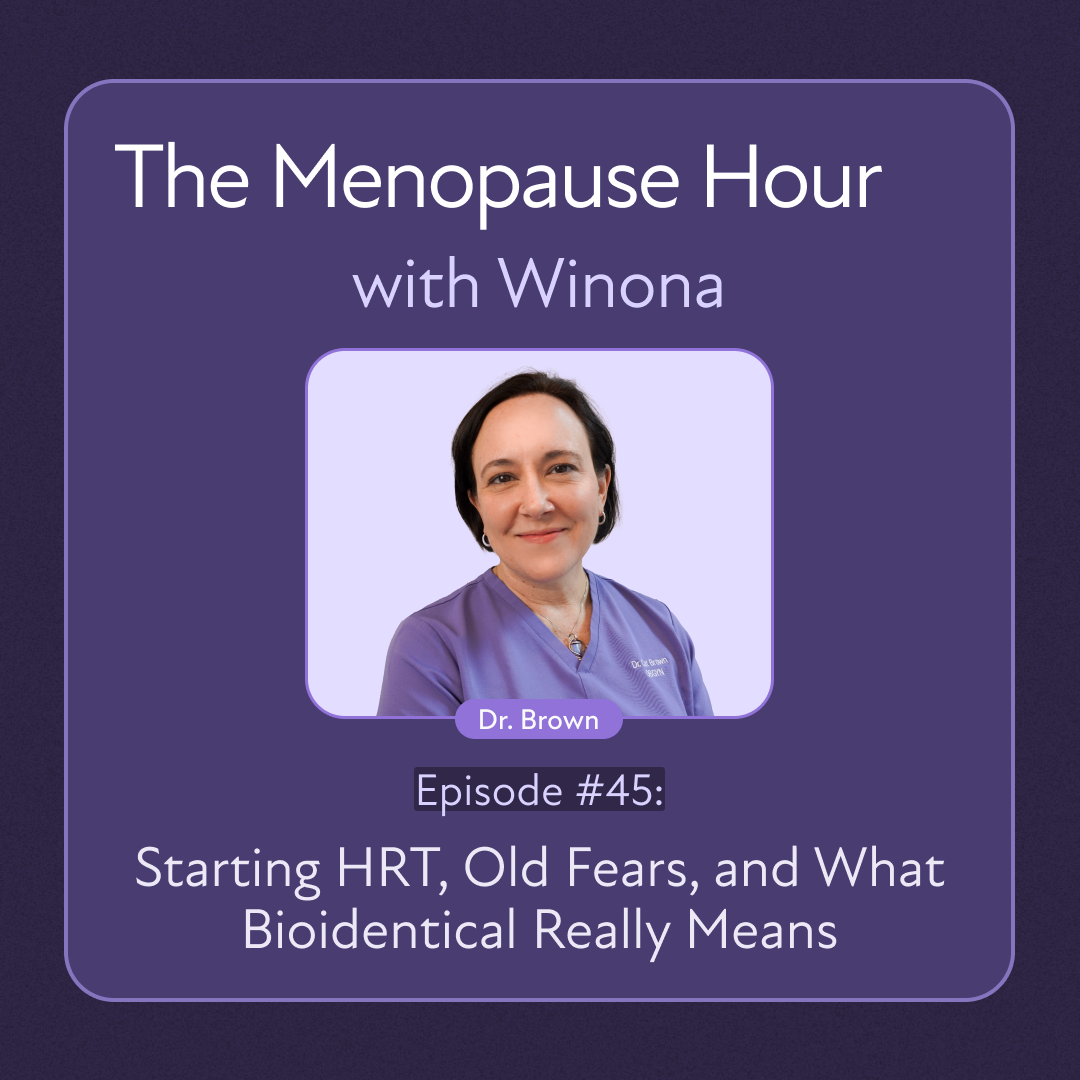
The Menopause Hour with Winona: Starting HRT, Old Fears, and What Bioidentical Really Means - Episode #45

Published: September, 2026

Dr. Cathleen Brown

Featured Physician

Cathleen M. Brown

Host

Madi Baldwin

Episode #45 of The Menopause Hour with Winona is a replay of a live Ask the Experts Q&A hosted by Winona community manager Madi Baldwin and Medical Director Dr. Cathleen Brown. The session focused on listener questions about starting and adjusting HRT, hair changes, and common concerns about hormone therapy safety.

Dr. Brown also explained what “bioidentical” means, how different HRT delivery methods compare, and why factors such as age, timing, medical history, and route of administration matter when considering treatment.


LISTEN TO THE EPISODE

Episode Details

  • Podcast: The Menopause Hour with Winona

  • Episode Number: 45

  • Episode Title: Starting HRT, Old Fears, and What Bioidentical Really Means

  • Host: Madi Baldwin

  • Featured Physician: Dr. Cathleen Brown

  • Published Date: September 11, 2026

  • Episode Duration: 61 minutes

  • Format: Menopause Q&A

  • Main Topics: Starting HRT, Bioidentical hormones, HRT safety fears

About The Menopause Hour with Winona Podcast

The Menopause Hour with Winona is a health and wellness podcast hosted by Winona’s Chief Medical Officer, Dr. Michael Green, and Medical Director, Dr. Cathleen Brown. The show addressed common questions about perimenopause and menopause through straightforward discussions of symptoms, treatment options, and the science behind the menopause transition.

Episodes included live Q&A sessions, doctor-led conversations, and patient stories shaped by questions women commonly bring to their own doctors. Produced by Winona, the podcast provides practical, accessible menopause information grounded in current research.

Visit The Menopause Hour on Buzzsprout.

About This Episode

This Ask the Experts session focused on practical questions that can come up when starting or adjusting HRT. Dr. Cathleen Brown discussed dosage changes, hair thinning, patch and cream application, constipation, and the meaning of the term “bioidentical.”

The episode also addressed broader safety questions, including how oral and transdermal estrogen differ, when the benefit-risk profile of systemic HRT is generally most favorable, and where vaginal estrogen may fit for women with genitourinary symptoms.

RSVP here to join our next Menopause Q&A.

Topics Covered

  • What "bioidentical" means and how it differs from synthetic hormones

  • When and how to adjust an HRT dosage

  • DHEA and its relationship to hair thinning

  • How HRT can support hair health through the skin's estrogen response

  • Best practices for patch placement and application

  • Applying estrogen and progesterone cream to non-hair-bearing skin

  • Why stroke risk is lower with transdermal HRT than oral pills

  • The safer window for starting systemic HRT around menopause

  • Vaginal estrogen as an option outside that window

  • Managing constipation after starting hormone therapy

  • Combining birth control with hormone replacement therapy

  • The connection between cholesterol and perimenopause

Key Takeaways

Bioidentical hormones match the structure of what the body already produces

Dr. Brown explained that bioidentical hormones have the same molecular structure as hormones produced by the body. The term itself does not determine whether a treatment is safer or more effective; formulation, dose, delivery method, and a woman’s individual health history also matter.

Transdermal HRT carries a lower stroke risk than oral pills

Oral estrogen passes through the liver before entering systemic circulation and can affect clotting factors. Dr. Brown explained that transdermal estrogen bypasses this first-pass liver metabolism and may carry a lower risk of blood clots than oral estrogen, which can be an important consideration when choosing a delivery method.

There's a safer window for starting systemic HRT around menopause

Dr. Brown noted that starting systemic hormone therapy has a higher risk after age 60 or more than ten years past a woman's final period. Outside that window, vaginal estrogen remains a safe, effective option for genitourinary symptoms.

DHEA is unlikely to cause hair loss at the doses Winona prescribes

Dr. Brown explained that hair loss is a known side effect of high-dose testosterone, but Winona starts patients on a low 25-milligram dose of DHEA. She noted that hormonal hair thinning during perimenopause is more often tied to the broader hormone shift than to DHEA itself.

Constipation after starting HRT often resolves with fiber, water, and time

Dr. Brown attributed post-HRT constipation to the body adjusting to a new hormone regimen. She recommended increasing dietary fiber, staying hydrated, and using a gentle over-the-counter option like MiraLAX if symptoms persist.

Cathleen M. Brown

Dr. Cathleen M. Brown

Obstetrics & Gynecology

Dr. Cathleen Brown is a menopause specialist and physician with Winona. She brings a physician’s perspective to menopause, perimenopause, hormone changes, symptom care, and treatment options during midlife.

At Winona, Dr. Brown helps women better understand symptoms, health history, hormone changes, and when physician-reviewed care may be appropriate.

Meet Dr. Cathleen M. Brown

Watch or Listen to the Episode

Watch the full conversation with Dr. Cathleen M. Brown on
The Menopause Hour with Winona with Madi Baldwin.

About Winona

Winona is a physician-led telehealth company focused on menopause and perimenopause care. Its board-certified physicians help women understand symptoms such as hot flashes, night sweats, sleep disruption, mood changes, brain fog, vaginal dryness, intimacy issues, weight changes, hair thinning, and joint discomfort.

When appropriate, Winona offers personalized treatment plans that may include hormone replacement therapy, bioidentical HRT, estrogen, progesterone, vaginal estrogen, and non-hormonal options. Winona also provides education and community support for women navigating hormone changes, menopause symptoms, perimenopause, and postmenopause.

To learn more, get started with Winona.

Get Physician-Led Menopause Care

Winona helps women access menopause and perimenopause care from home. Start with a short health questionnaire, and a board-certified physician will review your symptoms, health history, and treatment options.

Start Your Visit
lead-banner-woman-holding-mug-mobile