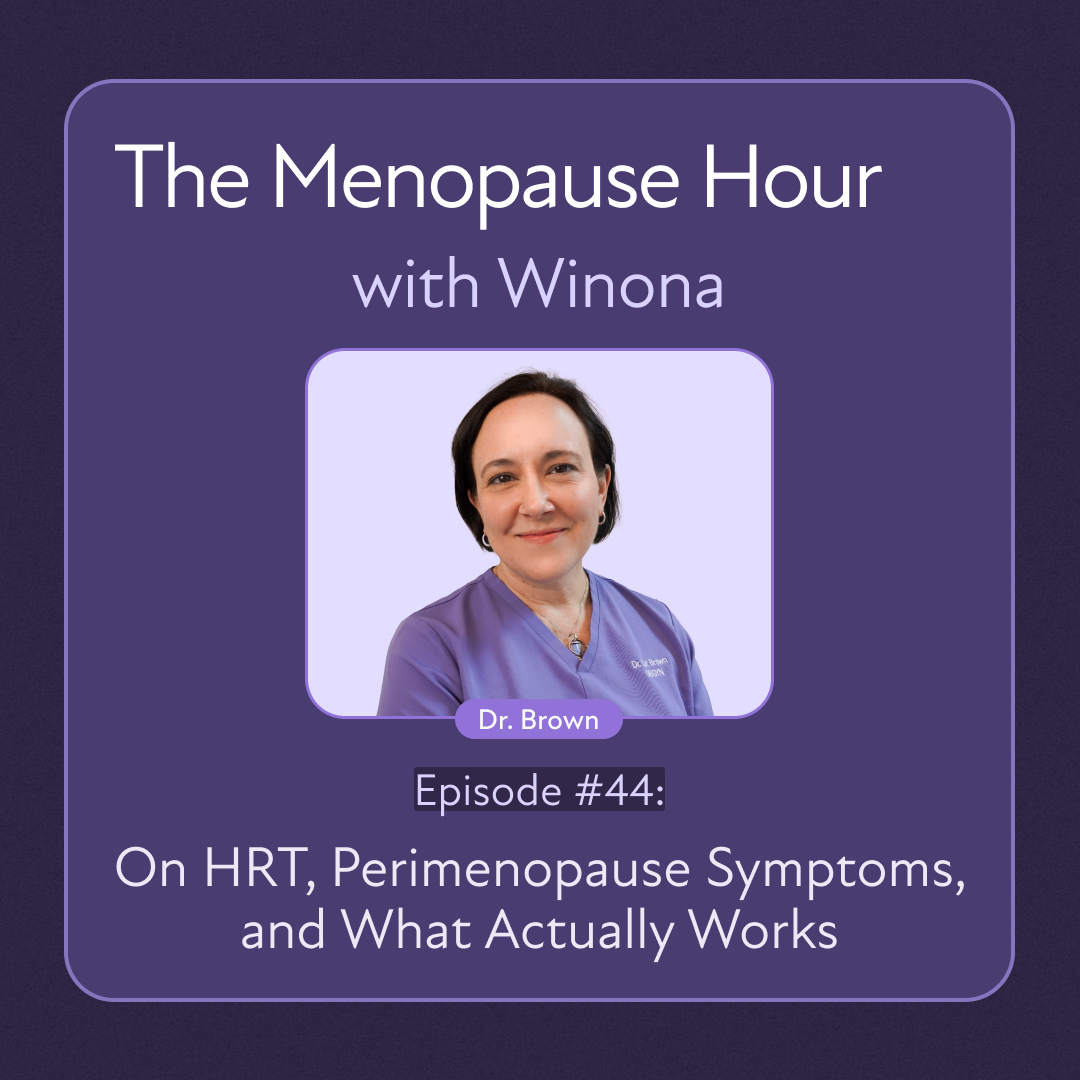

The Menopause Hour - Episode -44
Podcast

The Menopause Hour with Winona: On HRT, Perimenopause Symptoms, and What Actually Works - Episode #44

Published: September, 2026

Dr. Cathleen Brown

Featured Physician

Cathleen M. Brown

Host

Madi Baldwin

Episode #44 of The Menopause Hour with Winona was a replay of a live Ask the Experts Q&A, hosted by Winona community manager Madi Baldwin and featuring Winona Medical Director Dr. Cathleen Brown. The session covered everything from starting hormone replacement therapy (HRT) to recognizing when perimenopause symptoms may warrant treatment.

Dr. Brown answered listener questions about joint pain and hormone lab testing and addressed lingering fears about HRT rooted in outdated research. This episode offers a clear, evidence-based discussion about what the current science supports regarding hormone therapy for menopause.

LISTEN TO THE EPISODE

Episode Details

  • Podcast: The Menopause Hour with Winona

  • Episode Number: 44

  • Episode Title: Episode #44: On HRT, Perimenopause Symptoms, and What Actually Works

  • Host: Madi Baldwin

  • Featured Physician: Dr. Cathleen Brown

  • Published Date: September 9, 2026

  • Episode Duration: 39 minutes

  • Format: Menopause Q&A

  • Main Topics: HRT dosing, Perimenopause symptoms, Hormone testing

About The Menopause Hour with Winona Podcast

The Menopause Hour with Winona is a health and wellness podcast hosted by Winona Chief Medical Officer Dr. Michael Green and Medical Director Dr. Cathleen Brown. The show addresses common questions about perimenopause and menopause, combining medical expertise with straightforward discussions of symptoms, treatment options, and the science behind the menopause transition.

Episodes include live Q&A sessions, doctor-led conversations, and patient stories. In its live Q&A format, women from Winona's community submit questions directly to the hosts, creating practical discussions shaped by the concerns women commonly bring to their own doctors.

Visit The Menopause Hour on Buzzsprout.

About This Episode

In this replay of a Winona Ask the Experts Live Q&A, Dr. Cathleen Brown answered real-time questions from Winona's patient community about initiating HRT and identifying lesser-known symptoms of perimenopause. She also clarified how HRT research has evolved over time, helping to alleviate outdated fears.

Dr. Brown went on to explain why hormone lab testing isn’t necessary to start treatment, since natural hormone levels fluctuate too much throughout the day to give doctors actionable information about beginning treatment or dose adjustments. She noted that a symptom journal is a more reliable way to guide HRT decisions.

The discussion then shifted to musculoskeletal symptoms that often go unrecognized during perimenopause such as joint pain or frozen shoulder. Dr. Brown also addressed why some women experience temporary bloating when they first start hormone therapy. She closed the session by revisiting the Women's Health Initiative (WHI) study that sparked decades of hesitation around HRT, and how modern research has shaped current clinical guidelines.

RSVP here to join our next Menopause Q&A.

Topics Covered

  • Starting HRT while still having a period

  • Why hormone lab testing isn't recommended for confirming perimenopause

  • Musculoskeletal symptoms of perimenopause, including joint pain and frozen shoulder

  • The distinct roles of estrogen and testosterone in the body

  • How DHEA supports natural testosterone levels

  • Why weight changes after starting HRT are usually from temporary water retention

  • How the WHI study prompted widespread fears about HRT

  • Cardiovascular research on HRT when initiated around the time of menopause

  • How long it typically takes to experience relief on HRT

  • Choosing between different forms of bioidentical estrogen and progesterone 

  • Winona's new supplement line for perimenopause and menopause support

Key Takeaways

Hormone lab tests aren't a reliable way to manage perimenopause

Dr. Brown explained that hormone levels change significantly throughout the day, meaning a single blood draw only provides doctors with a snapshot of a patient’s hormonal activity. Tracking symptoms over time with a symptom journal or digital app gives doctors far more information to guide personalized treatment decisions.

Frozen shoulder and joint pain are common but often overlooked symptoms of perimenopause

As estrogen levels decline, the body’s connective tissues lose elasticity, impacting the tendons, ligaments, and joints. Dr. Brown noted that many women develop frozen shoulder or new joint stiffness during the menopause transition without realizing it may be hormone-related.

Early weight changes after starting HRT are usually a reflection of water retention, not fat gain

Starting hormone therapy can cause the tissues to hold excess water as the body adjusts to treatment. Dr. Brown emphasized that these early fluid shifts are temporary and not a reflection of fat gain. She recommended drinking plenty of water and prioritizing sleep to help the body process hormonal changes more quickly.

Fears around HRT largely trace back to a flawed, decades-old study

Dr. Brown pointed to the Women's Health Initiative (WHI) study as the primary source of HRT fears about cardiovascular and breast cancer risks. She noted that many study participants were well beyond the recommended age range for starting treatment. What the research findings actually showed was that combined treatment with synthetic estrogen and progestin (which are structurally different from the bioidentical hormones widely prescribed today) was associated with a small increased risk of breast cancer, but estrogen-only therapy was not.

Dr. Brown emphasized that modern research shows initiating HRT around the time of menopause is associated with reduced cardiovascular risk in appropriately screened patients.

Cathleen M. Brown

Dr. Cathleen M. Brown

Obstetrics & Gynecology

Dr. Cathleen Brown is a menopause specialist and physician with Winona. She brings a physician’s perspective to menopause, perimenopause, hormone changes, symptom care, and treatment options during midlife.

At Winona, Dr. Brown helps women better understand symptoms, health history, hormone changes, and when physician-reviewed care may be appropriate.

Meet Dr. Cathleen M. Brown

Watch or Listen to the Episode

Watch the full conversation with Dr. Cathleen M. Brown on
The Menopause Hour with Winona with Madi Baldwin.

About Winona

Winona is a physician-led telehealth company focused on menopause and perimenopause care. Its board-certified physicians help women understand symptoms such as hot flashes, night sweats, sleep disruption, mood changes, brain fog, vaginal dryness, intimacy issues, weight changes, hair thinning, and joint discomfort.

When appropriate, Winona offers personalized treatment plans that may include hormone replacement therapy, bioidentical HRT, estrogen, progesterone, vaginal estrogen, and non-hormonal options. Winona also provides education and community support for women navigating hormone changes, menopause symptoms, perimenopause, and postmenopause.

To learn more, get started with Winona.

Get Physician-Led Menopause Care

Winona helps women access menopause and perimenopause care from home. Start with a short health questionnaire, and a board-certified physician will review your symptoms, health history, and treatment options.

Start Your Visit
lead-banner-woman-holding-mug-mobile