The Menopause Hour Episode -12
Podcast

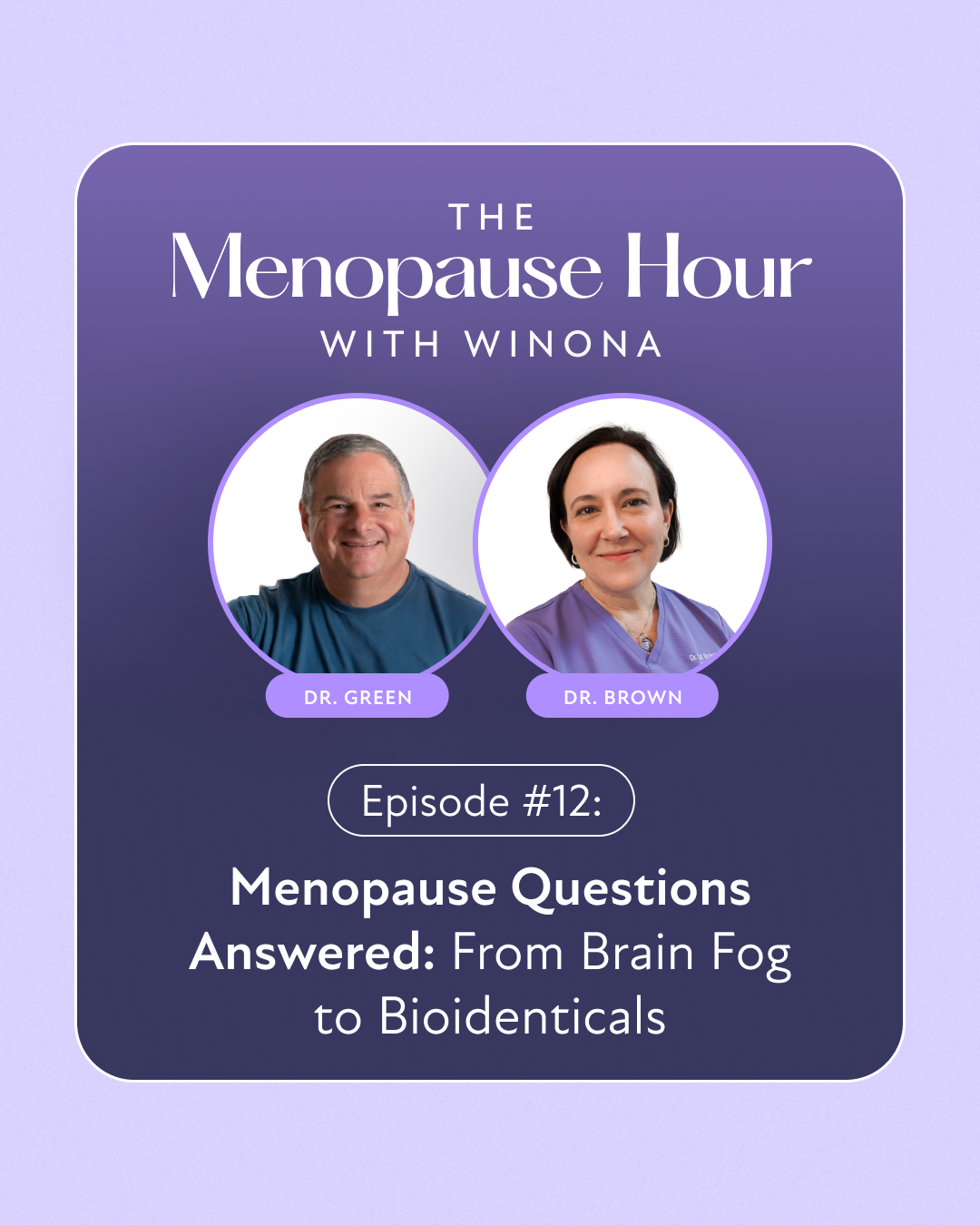
The Menopause Hour with Winona: Menopause Questions Answered: From Brain Fog to Bioidenticals - Episode #12

Published: May, 2025

Dr. Cathleen Brown

Featured Physician

Cathleen M. Brown

Host

Madi Baldwin

In Episode #12 of The Menopause Hour with Winona, Madi Baldwin hosted an Ask the Experts session with Dr. Michael Green and Dr. Cathleen Brown, titled "Menopause Questions Answered: From Brain Fog to Bioidenticals."

The doctors answered listener questions on brain fog and cognitive symptoms, migraine safety with HRT, personalized dosing without lab testing, caution around DHEA and testosterone, and long-term HRT safety. The conversation gave listeners a doctor's-level look at symptoms and treatment questions many face during perimenopause and menopause.


LISTEN TO THE EPISODE

Episode Details

  • Podcast: The Menopause Hour with Winona

  • Episode Number: 12

  • Episode Title: Episode #12: Menopause Questions Answered: From Brain Fog to Bioidenticals

  • Host: Madi Baldwin

  • Featured Physicians: Dr. Cathleen Brown

  • Published Date: May 2, 2025

  • Episode Duration: 57 min 19 sec

  • Format: Menopause Q&A

  • Main Topics: Brain fog & cognitive symptoms, HRT dosing without lab testing, DHEA safety

About The Menopause Hour with Winona Podcast

The Menopause Hour with Winona is a health and wellness podcast hosted by Winona's Chief Medical Officer, Dr. Michael Green, and Medical Director, Dr. Cathleen Brown. Each episode brings listeners candid, expert-led conversations that answer the menopause questions many women never get to ask their own OB/GYN.

The show mixes live Q&A sessions, doctor-to-doctor dialogues, and real patient stories to cover the full range of the menopause transition — symptoms, treatment options, and the science behind them — all aimed at helping women feel informed and confident rather than dismissed.

Visit The Menopause Hour on Buzzsprout.

About This Episode

In this live Q&A, Dr. Green and Dr. Cathleen Brown fielded listener questions on migraine safety with HRT, why hormone blood testing doesn't reliably guide dosing decisions, and how brain fog, joint pain, and fatigue during perimenopause and menopause often improve once estrogen is restored.

The doctors also addressed harder emotional questions, including how to weigh HRT's cancer risk against overall health, why DHEA and testosterone shouldn't be combined, and how starting hormone therapy after age 60 changes the safety profile. The episode provided clearer guidance for navigating both common and unusual symptoms during the transition.

RSVP here to join our next Menopause Q&A.

Topics Covered

  • Why migraines, even with aura, aren't a reason to avoid HRT

  • Facial skin peeling and how to introduce the estriol-tretinoin face cream gradually

  • Why hormone blood testing doesn't reliably guide HRT dosing

  • What to expect in the first few weeks of starting HRT, DHEA, and vaginal estrogen

  • Managing headaches and other side effects when starting hormone therapy

  • Brain fog, cognitive symptoms, and the overlap between perimenopause and ADHD

  • Weighing HRT's risks against cardiovascular health and overall wellbeing

  • Recurring premenstrual-like symptoms years after periods have stopped

  • Time-of-day adjustments for DHEA and progesterone based on individual response

  • Why DHEA shouldn't be combined with prescribed testosterone

  • Progesterone-only regimens and irregular bleeding

  • Combining HRT with GLP-1 medications for weight management

Key Takeaways

Migraines with aura aren't a reason to avoid HRT

Dr. Cathleen Brown explained that although migraine with aura can raise stroke risk with birth control pills, that risk doesn't carry over to bioidentical hormone therapy, since HRT restores the body's own hormone levels rather than suppressing them with high-dose synthetic hormones.

Hormone blood testing isn't a reliable guide to dosing

Because female hormone levels fluctuate throughout the day, Dr. Green and Dr. Brown treat based on symptoms rather than lab work, using a starting-dose algorithm and adjusting from there as a patient responds.

DHEA shouldn't be combined with prescribed testosterone

Dr. Green cautioned that DHEA is meant to gently support testosterone levels on its own — adding it on top of a testosterone prescription risks pushing levels too high, since testosterone already has a narrow safety margin in women.

Weighing HRT's risks means looking at the full health picture

Many women worry that HRT will cause breast cancer. Dr. Brown noted that combined estrogen and progesterone carries a modest increase in breast cancer risk, while estrogen alone does not raise it. She also touched on cardiovascular disease, which remains a leading health risk for women overall regardless of HRT use. The decision around HRT benefits from weighing the full picture rather than any single risk in isolation.

Brain fog and joint pain often improve with estrogen

Dr. Brown noted that estrogen is essential to neurotransmitter function, and many women who are misdiagnosed with ADHD or experience unexplained joint pain during perimenopause see improvement once estrogen is restored.

Cathleen M. Brown

Dr. Cathleen M. Brown

Obstetrics & Gynecology

Dr. Cathleen Brown is a menopause specialist and physician with Winona. She brings a physician’s perspective to menopause, perimenopause, hormone changes, symptom care, and treatment options during midlife.

At Winona, Dr. Brown helps women better understand symptoms, health history, hormone changes, and when physician-reviewed care may be appropriate.

Meet Dr. Cathleen M. Brown

Watch or Listen to the Episode

Watch the full conversation with Dr. Cathleen M. Brown on
The Menopause Hour with Winona with Madi Baldwin.

Get Physician-Led Menopause Care

Winona helps women access menopause and perimenopause care from home. Start with a short health questionnaire, and a board-certified physician will review your symptoms, health history, and treatment options.

Start Your Visit
lead-banner-woman-holding-mug-mobile