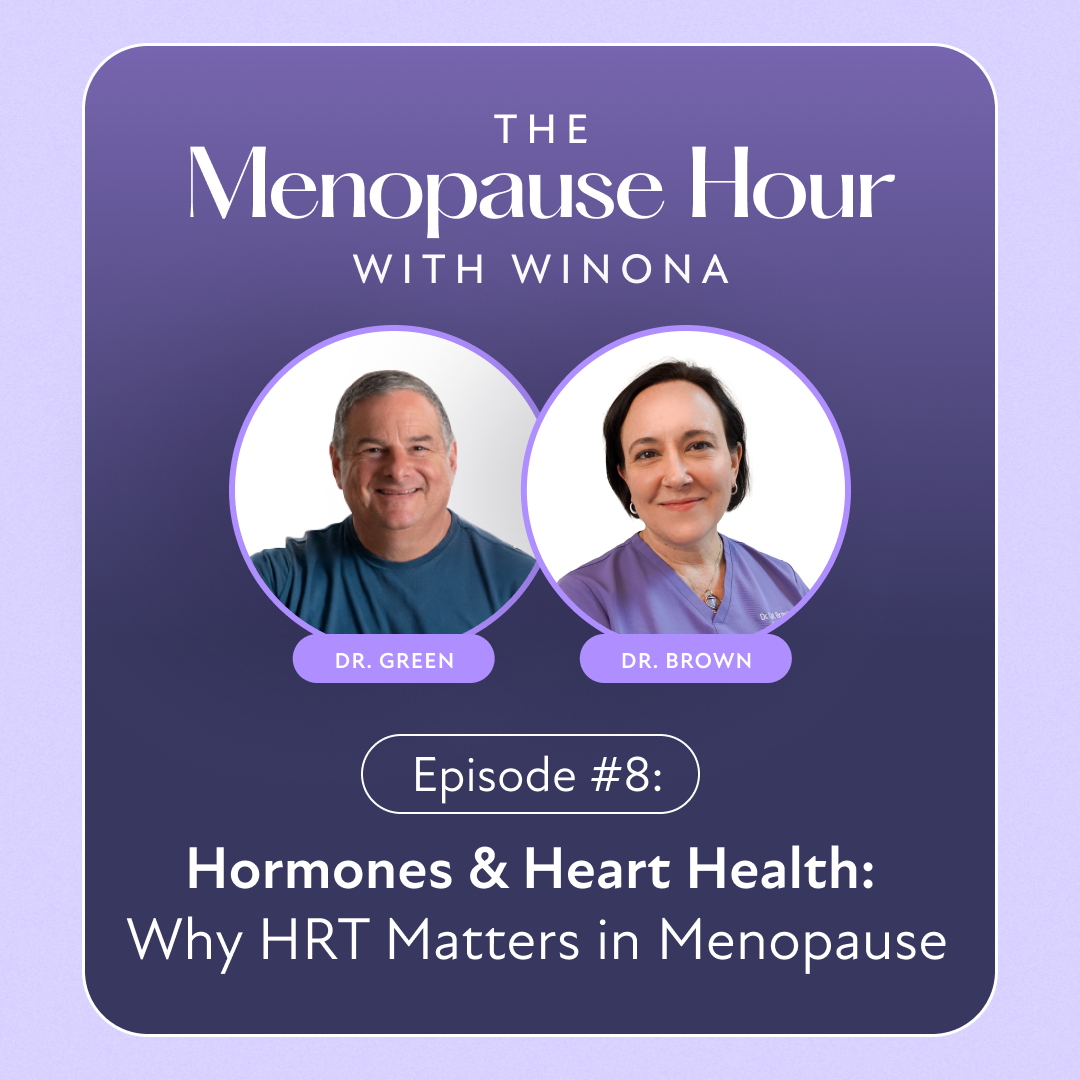
The Menopause Hour - Episode -8 Hormones & Heart Health Why HRT Matters in Menopause
Podcast

The Menopause Hour with Winona: Hormones & Heart Health: Why HRT Matters in Menopause - Episode #8

Published: March, 2026

Dr. Cathleen Brown

Featured Physician

Cathleen M. Brown

Host

Madi Baldwin

Episode #8 of The Menopause Hour with Winona is a replay of a live Ask the Experts Q&A with Winona's Chief Medical Officer Dr. Michael Green and Medical Director Dr. Cathleen Brown.

Timed to American Heart Month, the conversation breaks down how HRT affects cardiovascular risk, when starting hormone therapy after 60 becomes riskier, and real listener questions on bone density, weight gain, and testosterone — information intended for anyone considering HRT and its potential effects on heart health.

LISTEN TO THE EPISODE

Episode Details

  • Podcast: The Menopause Hour with Winona

  • Episode Number: 8

  • Episode Title: Episode #8: Hormones & Heart Health: Why HRT Matters in Menopause

  • Host: Madi Baldwin

  • Featured Physicians: Dr. Cathleen Brown

  • Published Date: March 5, 2025

  • Episode Duration: 1 hr 1 min

  • Format: Menopause Q&A

  • Main Topics: Heart health & HRT, Starting HRT after 60, Breast cancer risk & HRT

About The Menopause Hour with Winona Podcast

The Menopause Hour with Winona is a health and wellness podcast hosted by Winona's Chief Medical Officer, Dr. Michael Green, and Medical Director, Dr. Cathleen Brown. Each episode brings listeners candid, expert-led conversations that answer the menopause questions many women never get to ask their own OB/GYN.

The show mixes live Q&A sessions, doctor-to-doctor dialogues, and real patient stories to cover the full range of the menopause transition — symptoms, treatment options, and the science behind them — all aimed at helping women feel informed and confident rather than dismissed.

Visit The Menopause Hour on Buzzsprout.

About This Episode

This episode covers a live Ask the Experts session timed to American Heart Month, where Dr. Green and Dr. Cathleen Brown explained how hormone therapy interacts with cardiovascular health — including the nuanced, sometimes confusing data on why starting HRT after age 60 carries different risks than continuing treatment that began earlier. 

The conversation also features real listener questions on bone density, unexplained weight gain, testosterone alternatives like DHEA, and why hormone-level testing isn't needed to guide treatment. The episode explores what the evidence says about cardiovascular risk and addresses persistent misconceptions about HRT.

RSVP here to join our next Menopause Q&A.

Topics Covered

  • Why HRT is linked to lower long-term cardiovascular risk

  • The increased risk window when starting HRT for the first time after age 60

  • Vaginal estrogen as a safe option regardless of age

  • Bone density, osteopenia, and how HRT complements other bone-health treatments

  • Why hormone or blood testing isn't needed to guide HRT dosing

  • Managing weight gain tied to perimenopause and menopause

  • DHEA as an alternative to prescription testosterone

  • Why hormone pellets carry more risk than traditional HRT delivery methods

  • Combining HRT with an IUD or other birth control

  • How progesterone and estrogen work together to protect the uterus

  • Breast cancer risk: estrogen alone vs. combined estrogen and progesterone

  • Vaginal estrogen and Blossom cream for sexual wellness and libido

Key Takeaways

Long-term HRT use is linked to lower cardiovascular risk overall

Dr. Green noted that women who are appropriate candidates for HRT tend to have a longer, healthier life expectancy than those who never use it, largely due to estrogen's protective effect on blood vessels and heart tissue.

Starting HRT for the first time after 60 carries a different risk profile than continuing it

Dr. Cathleen Brown explained that beginning hormone therapy for the first time after age 60 raises cardiovascular risk in the first couple of years, but that risk doesn't apply to women who are already established on treatment before that age.

Breast cancer risk comes from the progesterone-estrogen combination, not estrogen alone

Dr. Cathleen Brown was clear that estrogen treatment itself does not increase breast cancer risk and may even lower it. The modest increase in risk shows up specifically when progesterone is combined with estrogen.

Hormone or blood testing isn't needed to guide HRT

Both doctors emphasized that major medical organizations, including the Menopause Society and ACOG, don't recommend baseline hormone labs since levels fluctuate too much to be useful. Treatment decisions are based on symptoms instead.

Hormone pellets carry more risk than traditional HRT

Dr. Green explained that pellets are typically testosterone-based, require an invasive insertion procedure, and can't be adjusted or removed easily if a patient has side effects — unlike creams, patches, or pills, which can be stopped or changed at any time.

Cathleen M. Brown

Dr. Cathleen M. Brown

Obstetrics & Gynecology

Dr. Cathleen Brown is a menopause specialist and physician with Winona. She brings a physician’s perspective to menopause, perimenopause, hormone changes, symptom care, and treatment options during midlife.

At Winona, Dr. Brown helps women better understand symptoms, health history, hormone changes, and when physician-reviewed care may be appropriate.

Meet Dr. Cathleen M. Brown

Watch or Listen to the Episode

Watch the full conversation with Dr. Cathleen M. Brown on
The Menopause Hour with Winona with Madi Baldwin.

Get Physician-Led Menopause Care

Winona helps women access menopause and perimenopause care from home. Start with a short health questionnaire, and a board-certified physician will review your symptoms, health history, and treatment options.

Start Your Visit
lead-banner-woman-holding-mug-mobile