The Menopause Hour - Episode -27
Podcast

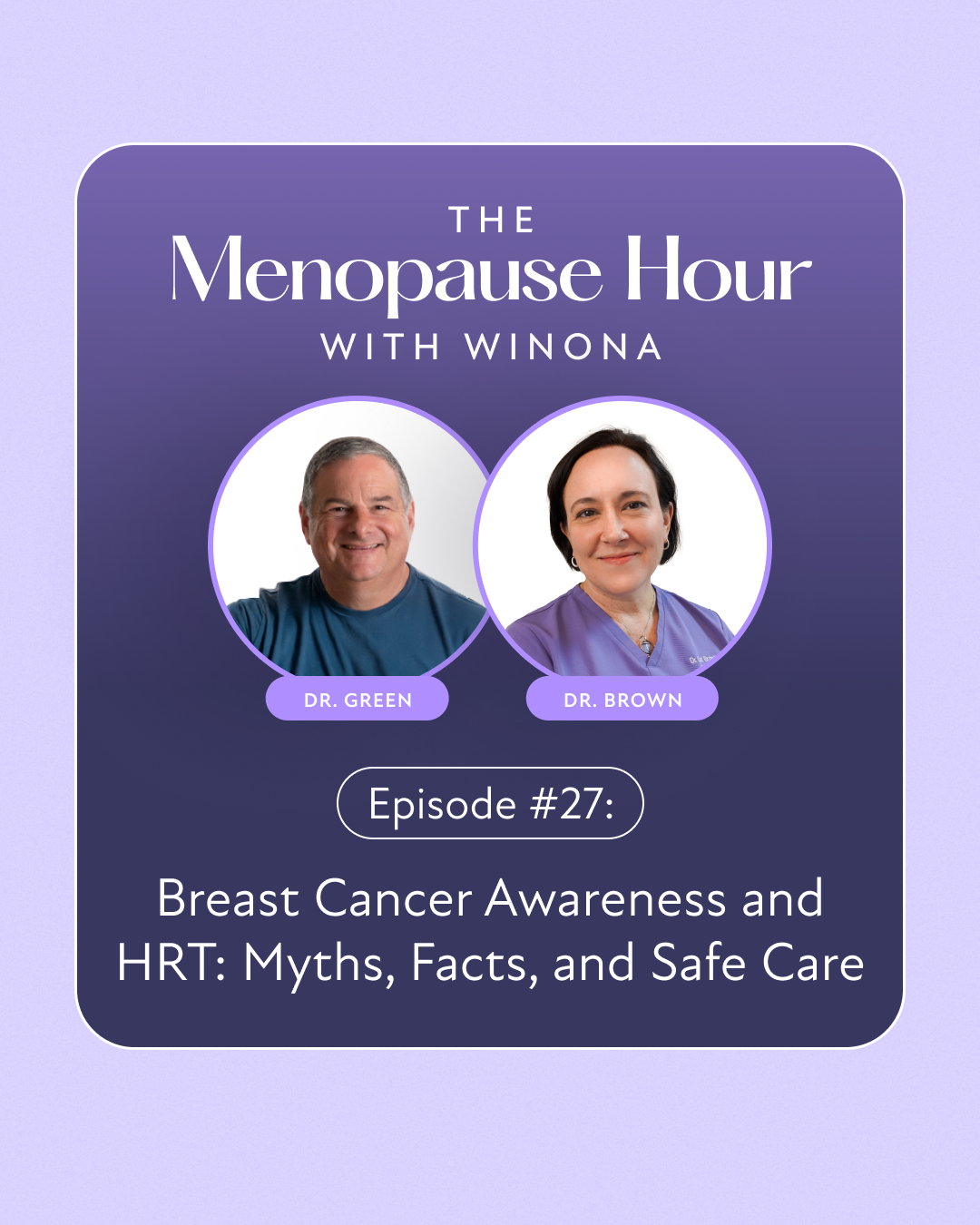
The Menopause Hour with Winona: Breast Cancer Awareness and HRT: Myths, Facts, and Safe Care - Episode #27

Published: October, 2025

Dr. Cathleen Brown

Featured Physician

Cathleen M. Brown

Host

Madi Baldwin

Episode #27 of The Menopause Hour with Winona was a Live Q&A hosted by Madi Baldwin with Winona's Chief Medical Officer Dr. Michael Green and Medical Director Dr. Cathleen Brown, titled "Breast Cancer Awareness and HRT: Myths, Facts, and Safe Care."

Recorded for Breast Cancer Awareness Month, the doctors addressed common fears about HRT and breast cancer risk, the value of regular mammograms, and questions on dosing, hysterectomy care, and hormone testing.


LISTEN TO THE EPISODE

Episode Details

  • Podcast: The Menopause Hour with Winona

  • Episode Number: 27

  • Episode Title: Episode #27: Breast Cancer Awareness and HRT: Myths, Facts, and Safe Care

  • Host: Madi Baldwin

  • Featured Physicians: Dr. Cathleen Brown

  • Published Date: October 17, 2025

  • Episode Duration: 1 hr

  • Format: Menopause Q&A

  • Main Topics: Breast cancer myths & HRT, Mammogram screening, Hormone testing myths

About The Menopause Hour with Winona Podcast

The Menopause Hour with Winona is a health and wellness podcast hosted by Winona's Chief Medical Officer, Dr. Michael Green, and Medical Director, Dr. Cathleen Brown. The show addresses common questions about perimenopause and menopause, combining medical expertise with straightforward discussions of symptoms, treatment options, and the science behind the menopause transition.

Episodes include live Q&A sessions, doctor-led conversations, and patient stories. In its live Q&A format, women from Winona's community submit questions directly to the hosts, creating practical discussions shaped by the concerns women commonly bring to their own doctors.

Visit The Menopause Hour on Buzzsprout.

About This Episode

Timed with Breast Cancer Awareness Month, this episode opened with a reminder to keep up with mammograms and breast exams. Dr. Green explained that mammogram radiation exposure is minimal, and screening remains one of the most effective ways to catch breast cancer early, when it's most treatable.

The doctors then took listener questions on one of the most common fears patients bring to HRT: breast cancer risk. Dr. Green explained that a family history alone isn't disqualifying, and went over how estrogen and progesterone affect that risk differently. He was careful to frame HRT's cardiovascular and cognitive benefits as separate considerations from breast cancer risk rather than points that offset it. The conversation also covered dosing, hysterectomy care, and why hormone testing still isn't part of how Winona guides treatment.

RSVP here to join our next Menopause Q&A.

Topics Covered

  • Breast Cancer Awareness Month and the importance of regular mammograms

  • Why mammogram radiation risk is minimal compared to its screening benefit

  • Abnormal bleeding and spotting when starting HRT

  • Introducing tretinoin cream slowly to avoid excess dryness

  • Comparing Winona's compounded HRT to medications from an in-person doctor

  • Starting with a low HRT dose and adjusting gradually based on symptoms

  • Family history of breast cancer versus a known genetic marker like BRCA

  • How estrogen and progesterone differ in their effect on breast cancer risk

  • HRT options for women who've had a hysterectomy but kept their ovaries

  • Estrogen's possible role in supporting cognitive health

  • Why hormone and Dutch urine testing aren't used to guide treatment

  • Heart palpitations and other symptoms tied to fluctuating hormone levels

Key Takeaways

Mammogram screening benefits far outweigh its minimal radiation risk

Dr. Green explained that mammogram radiation exposure is minimal. Screening guidelines are built around catching breast cancer early, when it's most treatable. Regular mammograms and breast exams remain one of the most effective tools for catching problems early.

A family history of breast cancer doesn't rule out HRT on its own

Dr. Green explained that most breast cancers occur without a hereditary cause, so a family history alone usually isn't disqualifying. A known genetic marker like BRCA changes the picture and typically calls for in-person evaluation rather than telehealth.

Estrogen and progesterone affect breast cancer risk differently

Older research found that estrogen alone was associated with a slightly lower breast cancer risk, while combined estrogen and progesterone showed a modest increase. Dr. Green noted that newer research on the bioidentical, micronized progesterone used at Winona suggests it may not carry that same increased risk, though the data isn't yet conclusive.

Cardiovascular and cognitive benefits stand on their own, separate from breast cancer risk

Dr. Green pointed to research showing HRT is associated with lower cardiovascular risk and may help support cognitive health. These are separate clinical considerations from breast cancer risk, not points that offset or outweigh it. A doctor weighs both as part of a patient's overall health picture.

Hormone and urine metabolite testing still isn't used to guide HRT

Dr. Green reiterated that hormone levels fluctuate too much throughout the day to be useful, and that tests like Dutch urine testing aren't backed by the ACOG or The Menopause Society. Treatment is best guided by symptoms, not lab numbers.

Cathleen M. Brown

Dr. Cathleen M. Brown

Obstetrics & Gynecology

Dr. Cathleen Brown is a menopause specialist and physician with Winona. She brings a physician’s perspective to menopause, perimenopause, hormone changes, symptom care, and treatment options during midlife.

At Winona, Dr. Brown helps women better understand symptoms, health history, hormone changes, and when physician-reviewed care may be appropriate.

Meet Dr. Cathleen M. Brown

Watch or Listen to the Episode

Watch the full conversation with Dr. Cathleen M. Brown on
The Menopause Hour with Winona with Madi Baldwin.

Get Physician-Led Menopause Care

Winona helps women access menopause and perimenopause care from home. Start with a short health questionnaire, and a board-certified physician will review your symptoms, health history, and treatment options.

Start Your Visit
lead-banner-woman-holding-mug-mobile