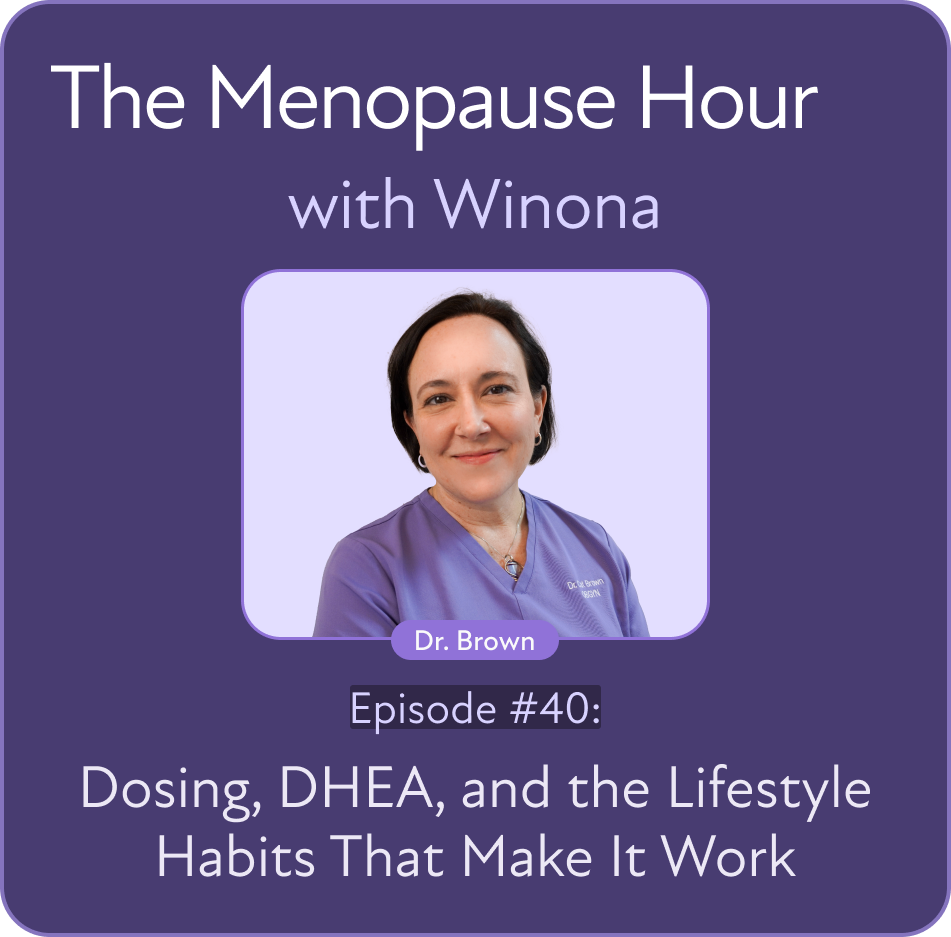
The Menopause Hour: Ask the Experts: Live Doctor Q&A Episode #40 Dosing, DHEA, and the Lifestyle Habits That Make It Work
Podcast

The Menopause Hour with Winona: Dosing, DHEA, and the Lifestyle Habits That Make It Work - Episode #40

Published: June, 2026

Dr. Cathleen Brown

Featured Physician

Cathleen M. Brown

Host

Madi Baldwin

Episode #40 of The Menopause Hour with Winona was a replay of a live Ask the Experts Q&A, hosted by Winona's Madi Baldwin and featuring Medical Director Dr. Cathleen Brown answering listener questions. Much of the discussion focused on DHEA, including dosing protocols, precautions for women with PCOS or bipolar disorder, and its clinical role in supporting energy and weight management.

The conversation also covered progesterone absorption, best practices for switching between the estrogen patch and progesterone pill to the combined estrogen-progesterone cream, and why water retention and bloating are common during the first few weeks of hormone therapy. Dr. Brown closed the episode by discussing clinical guidelines regarding long-term HRT use, the risks and benefits involved, and which vitamins can support women’s health during the menopause transition.


Apple Podcast

Episode Details

  • Podcast: The Menopause Hour with Winona

  • Episode Number: 40

  • Episode Title: Episode #40: Dosing, DHEA, and the Lifestyle Habits That Make It Work

  • Host: Madi Baldwin

  • Featured Physician: Dr. Cathleen Brown

  • Published Date: June 17, 2026

  • Episode Duration: 53 minutes 12 seconds

  • Format: Menopause Q&A

  • Main Topics: HRT Dosing, DHEA, Lifestyle Habits

About The Menopause Hour with Winona Podcast

The Menopause Hour with Winona is a health and wellness podcast featuring Winona Chief Medical Officer Dr. Michael Green and Medical Director Dr. Cathleen Brown. The show addresses common questions about perimenopause and menopause, combining medical expertise with straightforward discussions of symptoms, treatment options, and the science behind the menopause transition.

Episodes include live Q&A sessions, doctor-led conversations, and patient stories. In its live Q&A format, women from Winona's community submit questions directly to the hosts, creating practical discussions shaped by the concerns women commonly bring to their own doctors.

Visit The Menopause Hour on Buzzsprout.

About This Episode

This live Q&A focused heavily on DHEA questions, with Dr. Brown addressing clinical precautions for women with PCOS or bipolar disorder, its role in weight management and preserving lean muscle mass, and how pharmaceutical-grade formulations compare to over-the-counter DHEA products.

She also covered progesterone absorption through the skin, why Winona uses micronized progesterone in its topical cream for endometrial protection, and how to seamlessly switch between delivery methods like patches, creams, and pills.

Listener questions additionally touched on strategies for managing early side effects like water retention, bloating, and mild anxiety. Dr. Brown also discussed HRT duration, long-term risks and benefits of estrogen therapy, and how alcohol consumption compares to HRT as a breast cancer risk factor. She closed the show with recommendations on vitamins like calcium, vitamin D, and magnesium to support women’s changing health needs during the menopause transition.

RSVP here to join our next Menopause Q&A.

Topics Covered

  • How PCOS symptoms can complicate the perimenopause transition

  • Vaginal estrogen cream for dryness and UTI prevention

  • Switching between patch, cream, and pill delivery methods

  • Progesterone absorption and why Winona uses micronized progesterone

  • DHEA precautions for women with PCOS or bipolar disorder

  • Managing anxiety, heart palpitations, or brain fog when starting treatment

  • DHEA's role in weight management, muscle mass, and energy

  • Water retention and bloating in the first weeks of HRT

  • How long women typically stay on hormone therapy

  • Long-term risks and benefits of HRT, including breast cancer context

  • Best areas of the body to apply estrogen cream

  • Vitamins and supplements that support the menopause transition

Key Takeaways

DHEA requires extra caution for women with PCOS or bipolar disorder

Dr. Brown explained that DHEA slightly raises testosterone levels, which can be a concern for women actively managing PCOS symptoms like excess hair growth. Alternatively, high doses of DHEA may trigger a manic episode in women with a history of bipolar disorder with mania. She emphasized that Winona uses standard, low-dose DHEA.

Progesterone absorption concerns are addressed through micronization

Dr. Brown clarified that Winona's topical progesterone uses micronized progesterone, formulated to be more absorbable through the skin for reliable endometrial protection. While some patients prefer oral micronized progesterone, she noted that Winona's topical cream doses have been used safely and effectively by thousands of patients since 2021.

Water retention and bloating are common in the first few weeks of HRT

Dr. Brown explained that early bloating and water retention are common side effects as the body adjusts to new hormone levels. Noticeable changes in visceral fat distribution or body composition from HRT tend to show up closer to the six-month mark. She recommended not focusing on the scale during the first few weeks of treatment and instead prioritizing sleep, nutrition, and stress reduction while hormones reach a steady state in the blood.

There's no fixed timeline for how long women can remain on HRT

Dr. Brown stated that most women stay on hormone therapy for an average of three to five years to cover the most symptomatic phase of the menopause transition. However, many women are choosing to continue treatment for longer given evolving data on cardiovascular, bone, and cognitive benefits. She emphasized that stopping treatment is an individualized decision to be made between a patient and their doctor.

Alcohol consumption is a more significant risk factor for breast cancer than HRT for most women

Dr. Brown explained that moderate daily alcohol consumption is associated with a higher relative breast cancer risk than taking hormone therapy, adding that estrogen-only therapy (for women without a uterus) is associated with a reduced risk of breast cancer. She encouraged listeners to weigh the risks and benefits of HRT holistically rather than avoiding it out of fear alone.

Cathleen M. Brown

Dr. Cathleen M. Brown

Obstetrics & Gynecology

Dr. Cathleen Brown is a menopause specialist and physician with Winona. She brings a physician’s perspective to menopause, perimenopause, hormone changes, symptom care, and treatment options during midlife.

At Winona, Dr. Brown helps women better understand symptoms, health history, hormone changes, and when physician-reviewed care may be appropriate.

Meet Dr. Cathleen M. Brown

Watch or Listen to the Episode

Watch the full conversation with Dr. Cathleen M. Brown on
The Menopause Hour with Winona with Madi Baldwin.

Get Physician-Led Menopause Care

Winona helps women access menopause and perimenopause care from home. Start with a short health questionnaire, and a board-certified physician will review your symptoms, health history, and treatment options.

Start Your Visit
lead-banner-woman-holding-mug-mobile